LED ceiling light for living rooms, kitchens and hallways
Eine LED-Deckenleuchte eignet sich als Grundbeleuchtung für Flur, Küche, Schlafzimmer und kleinere Wohnräume, weil sie Licht von der Decke aus verteilt und keine Stellfläche benötigt. Diese Form der Deckenbeleuchtung ist praktisch, wenn Möbel, Türen und Laufwege wenig Spielraum lassen. Die Bauform entscheidet, ob das Licht breit im Raum verteilt wird, einzelne Bereiche betont oder die Leuchte flach an der Decke bleibt. Dadurch passen LED-Deckenleuchten zu unterschiedlichen Wohnsituationen, vom schmalen Eingangsbereich bis zum offenen Essplatz.
Choose an LED ceiling light that suits the room and its intended use
A ceiling light fitted with LED technology should be suited to the lighting requirements of the room in question, such as providing guidance in a hallway, facilitating work in the kitchen, or creating subtle ambient lighting in the bedroom. In the hallway, bright, even lighting makes it easier to settle in, hang up coats and find your shoes. In the kitchen, clear lighting is important to ensure that work surfaces, cupboards and walkways remain clearly visible. In the bedroom, less direct light is often sufficient to keep the room well-lit without being too harsh.
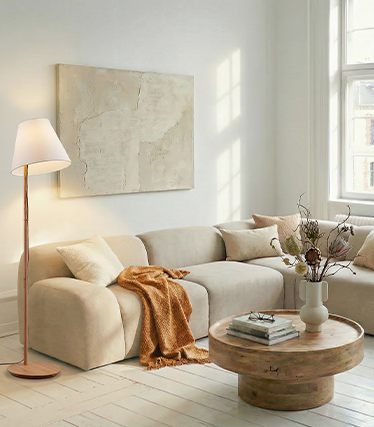
In living spaces, the choice depends more on the floor plan. A central LED ceiling lamp can fully illuminate smaller rooms. In larger rooms, a single light is often not enough, as the seating area, shelving unit and dining table are used for different purposes. In larger rooms, a combination of ceiling lights, wall lights or floor lamps can distribute the light across the seating area, shelving unit and dining table. An LED ceiling lamp then provides the general lighting, whilst additional lights illuminate specific areas. This ensures that the lighting remains suitable for everyday use, without the room being reliant on a single light source.
LED panel ceiling lights, LED downlights and low-profile designs
Die Bauform entscheidet stark darüber, wie sich das Licht im Raum verteilt. Eine LED-Panel-Deckenleuchte ist auf eine breite und gleichmäßige Lichtverteilung ausgelegt. Diese Bauform eignet sich gut für Räume, in denen eine gleichmäßige Helligkeit zählt, etwa für Küche, Hauswirtschaftsraum, Arbeitszimmer oder Flur. Durch die flache Form bleibt sie optisch zurückhaltend und stört auch bei niedrigen Decken kaum.
LED-Deckenstrahler richten das Licht gezielter aus. Sie sind sinnvoll, wenn einzelne Bereiche heller sein sollen, zum Beispiel eine Küchenzeile, ein Schrank, ein Bild oder eine Leseecke. Auch der Abstrahlwinkel ist relevant: Ein größerer Winkel verteilt Licht breiter, ein kleinerer Winkel betont einzelne Flächen stärker. Verstellbare mehrflammige Deckenstrahler lassen sich in verschiedene Richtungen ausrichten und helfen dabei, längliche Räume besser aufzuteilen. Runde oder quadratische LED-Deckenlampen wirken dagegen kompakter und geben dem Raum eine ruhigere Grundstruktur. Bei sehr niedrigen Decken sind flache LED-Leuchten für die Decke oft angenehmer als abgehängte Varianten, weil sie Kopffreiheit und Blickachsen erhalten.
Dimmable LED ceiling lights and light colour in everyday life
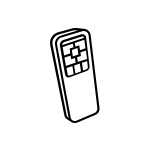
A dimmable ceiling light with LED technology is useful when the same room serves multiple purposes. In the living room, bright light can make tidying up or reading easier, whilst a dimmer setting is more pleasant in the evening. In the dining area, dimmed lighting can create a more relaxed atmosphere when the table isn’t being used as a work surface. With ceiling lights that come with a remote control, the brightness can be adjusted directly, depending on the model, without the need for a separate wall-mounted dimmer switch. Models with adjustable light colour – often referred to as the CCT function – switch between warm white, cool white and daylight, depending on the model.
The light colour also affects how it is used. Warm white is particularly suitable for living rooms and bedrooms where you want the light to be softer and less clinical. Cool white is ideal for kitchens, hallways or workspaces where colours and shapes need to be clearly visible. Daylight is more suitable for hobby rooms or ancillary rooms where a more neutral lighting is desired. For general lighting in living areas, 100 to 150 lumens per square metre can serve as a rough guide, provided there are no additional requirements regarding brightness.
Coordinate your LED ceiling lamp with your furniture, colours and materials
An LED ceiling lamp should not only be bright enough, but also complement the décor. White or very flat designs blend in with light-coloured ceilings and are well suited to minimalist interiors. Black lights or exposed metal surfaces stand out more and go well with furniture featuring clean lines, dark handles or open shelving. Wooden details can complement rooms with natural materials in a subtle way, without the light itself drawing too much attention.
The shape should follow the existing lines. Round ceiling lights go well with round dining tables, soft-edged sofas or oval mirrors. Angular LED ceiling lights go well with straight kitchen units, rectangular tables or narrow hallways. In open-plan living spaces, a recurring colour can help to visually link different areas. The light does not necessarily have to match every piece of furniture. A clear reference to handles, table frames, door fittings or window frames is often sufficient.
Planning LED lights on the ceiling safely: IP code and installation conditions
When it comes to LED bulbs for the ceiling, the installation situation is a key factor. Before making a purchase, you should decide whether to use an existing ceiling outlet, whether the light will be mounted directly on the ceiling, or whether you plan to install recessed spotlights. LED recessed spotlights require a suitable installation depth and sufficient space in the ceiling, as they are not mounted on the ceiling surface. In rented flats, surface-mounted lights are often more straightforward because they can be installed without the need for major structural alterations.
The IP code is important in bathrooms, basements, hallways and covered outdoor areas. The IP code is a measure of how well a light is protected against moisture or foreign objects. Different requirements apply in dry living spaces than in areas close to water or with high humidity. In the bathroom, the appropriate IP code depends on how close the light is to the shower, bath or washbasin. A ceiling light with a motion detector can be useful in hallways, storage rooms or basements, as the light switches on automatically as soon as someone enters the area. In a windowless guest toilet, it is important to ensure that the ceiling connection near the washbasin has a suitable IP code.